Full re-roofing across Malmesbury and surrounding Wiltshire — free survey, itemised quote, written 10-year guarantee. All materials and specification options explained clearly before any commitment.
In short: Roof Replacement in Malmesbury: A re-roof runs from around £5,500 for a terrace to £15,000+ for a large detached. We cover Malmesbury and the surrounding SN16 area with free quotes, no call-out fee, and a 10-year workmanship guarantee. A full re-roof is the right call once repairs stop making sense or the covering is past its life.
A complete re-roof is not just new tiles. Here is what every re-roof in Malmesbury includes as standard.
🔍
Full Survey
Free survey assessing tile condition, batten and felt condition, lead status, ridge and hip, guttering and chimney. Written findings provided before any quote is agreed.
📌
Strip & Inspect
All tiles stripped, existing felt and battens removed. Roof deck inspected for rotten or damaged boards. Any structural issues identified before work proceeds.
🏠
New Felt & Battens
BS5534-compliant underlay and pressure-treated battens throughout. No re-use of deteriorated battens — this is where corners are most often cut by cheaper contractors.
⬤
Lead Valleys & Flashings
Lead valleys, chimney flashings and abutment flashings replaced in correct code weights as part of the re-roof. Not patched over existing lead.
🔧
Tile Fixing
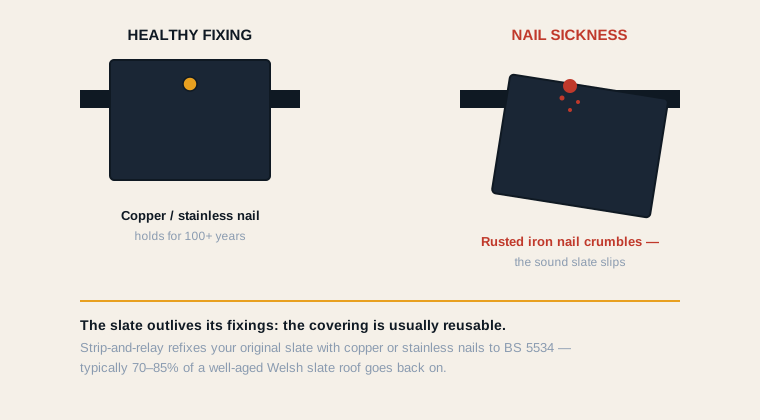
Tiles fixed with stainless steel nails or clips — never original mild steel that will corrode again in 30 years. Correct fixing pattern for tile type and roof pitch.
📋
10-Year Guarantee
Written workmanship guarantee covering all installation work. Clear terms, not small print. Provided on completion alongside invoice and specification record.
Why Malmesbury Specifically
Roof Replacement in Malmesbury — What Makes This Location Different
Local Climate and Exposure
Malmesbury's exposed hilltop position — the highest town in Wiltshire — means stronger wind loading and faster mortar fatigue than any valley location in our coverage area. For roof replacement work in Malmesbury, this means specification choices that reflect the actual conditions rather than generic Wiltshire averages.
Housing Stock Profile
Medieval and Georgian town centre properties require conservation-appropriate materials; 1960s–80s estates below the hill use standard modern specifications. We are 10 miles north from Malmesbury — 20 minutes — with no travel surcharge and same local knowledge that applies to every property type in this area.
A full re-roof is the right call once repairs stop making sense or the covering is past its life in Malmesbury. Malmesbury is England's oldest borough — a hilltop town of Cotswold-stone cottages, stone-slate and clay roofs, and a dense historic conservation core around the Abbey. On this kind of stock, the common problems are exposed stone-slate roofs losing slates to wind, lime-pointing failure on Cotswold-stone stacks, and heritage repairs on listed stock — and knowing which you are dealing with is the difference between a lasting fix and money wasted.
National roofing standards illustrated. We advise on your specific Malmesbury roof after a free survey.
Local Knowledge
Re-Roofing in Malmesbury
A full re-roof in Malmesbury requires material awareness from the outset. The town centre's Cotswold stone buildings must use stone slate or clay plain tile to conservation area and listed building specification — concrete tile is never appropriate and would require planning consent. The 1960s–70s estate stock below the hill is increasingly presenting as re-roof candidates: nail sickness at this age is usually system-wide, and a roof where tiles are sliding regularly is past the repair-and-maintain phase.
Scaffold in Malmesbury's narrow medieval street pattern requires advance notice with the town council for street occupation. We handle permit applications as part of the re-roof project management — this is routine for us but something inexperienced contractors frequently overlook. All re-roofs carry a written 10-year workmanship guarantee. Free full survey and itemised quote before any commitment.
Chippenham Roofing Experts
📍 Serving Malmesbury, Wiltshire
📞 01249 247 076
📌 10 miles north of Chippenham (20 minutes)
⚡ Emergency: 24/7
We measure the roof, inspect the structure from the loft, and confirm the tile match and planning position.
2. Itemised quote
A written quote breaking scaffold, strip, membrane, battens, tiles, lead and guarantee out separately.
3. Scheduling
We agree scaffold dates and the timeline — typically 3–8 working days for a semi.
4. Access day
Scaffold goes up; the old covering is stripped and disposed of.
5. The work & sign-off
New membrane, battens, tiles, ridge and lead fitted; the roof is signed off with a 10-year guarantee.
Timescales
How Long Roof Replacement Takes
Job
Typical duration
Terraced re-roof (concrete)
3–5 days
Semi-detached re-roof (concrete)
4–6 days
Semi-detached re-roof (clay)
5–8 days
Detached / complex roof
7–12 days
Scaffold up to strike
+1 day each end
Sustained rain or high wind pauses stripping and tiling; we never leave a roof open overnight and re-cover progressively.
Access
Access, Scaffold & Permits in Malmesbury
Malmesbury's hilltop stone streets are steep and narrow with no rear access, and the conservation area often requires natural stone slate and lime mortar. Pavement scaffold and skip permits in Malmesbury go through Wiltshire Council; on tight streets like the High Street, Gloucester Street, Oxford Street we allow extra time for setup and access.
Pricing
Roof Replacement Prices in Malmesbury
A re-roof runs from around £5,500 for a terrace to £15,000+ for a large detached. Malmesbury pricing tracks Chippenham, adjusted for access on Malmesbury's stock.
Job
Typical range
Notes
Terraced re-roof (concrete)
£5,500–£9,000
Incl. scaffold & strip
Semi-detached (concrete tile)
£6,500–£11,500
Incl. scaffold, membrane, battens
Semi-detached (clay tile)
£9,500–£15,500
Conservation-grade where required
Detached (concrete)
£9,000–£16,000
Larger area & complexity
Detached (clay or slate)
£13,000–£22,000
Heritage / listed stock
Per m² — concrete / clay
£85–£130 / £110–£170
Supplied & fitted
No payment before materials are on site. Staged payments on a re-roof, tied to progress. VAT included in every quote. No large upfront deposit — a demand for one is a rogue-trader warning sign.
Covering SN16 and surrounding postcodes.
Guarantee
Your Malmesbury Guarantee
The full re-roof carries a 10-year workmanship guarantee in writing, transferable if you sell; tiles and membrane carry their own manufacturer product guarantees.
Covered: workmanship for 10 years, in writing, transferable.
On top: manufacturer warranties on materials.
Not covered: storm or impact damage — an insurance matter we document for you.
Good to know
Disruption, Mess & Weather
Several days of scaffold, noise during strip and battening, and skip access needed — we protect the garden and drive and clear all waste on completion. You do not need to stay home for external work.
Re-roofs run year-round but are weather-managed; we strip only what we can re-cover the same day and sheet against rain. Malmesbury's hilltop position between two branches of the Avon leaves it fully exposed to wind on all sides.
Customer Reviews
Re-Roofing Reviews — Malmesbury
★★★★★
"Full re-roof on a 1975 semi — all four slopes nail-sick. Scaffold managed despite the narrow street access. Done in four days, correct tile profile, guarantee in writing. Couldn't ask for more."
D. Morse · Bristol Street, Malmesbury
★★★★★
"Georgian townhouse — required clay plain tile to conservation spec. Sourced correctly, lime mortar throughout, no issues with the planning officer. Professional from survey to final inspection."
A. Croft · Malmesbury town centre
★★★★★
"Village farmhouse re-roof in stone slate — large and complex. Properly specified, competitively priced, delivered on time. The team clearly knew what they were doing with this type of building."
T. Hayward · Sherston, near Malmesbury
Pricing Guide
Re-Roofing Costs in Malmesbury
Concrete Tile
£5,500–£8,500
Three-bed semi. Includes felt, battens, ridge and hip.
Clay Tile
£7,000–£10,500
Longer lifespan. Better suited to period properties.
Natural Slate
£9,000+
Welsh or Spanish slate. Required for some listed properties.
Full Survey
Free
Written findings and itemised quote. No obligation.
FAQ
Common Questions
Historic properties in the town centre require clay plain tile, stone slate, or natural Welsh slate to conservation specification. Concrete tile is not acceptable on listed or conservation area properties. We advise on material requirements during the free survey.
Three-bed semi in concrete interlocking tile: £5,500–£8,500. Clay tile specification: £7,000–£10,500. Stone slate or conservation area properties: from £9,000 depending on scope. Free itemised quote before any commitment.
We apply for highway occupation permits through Wiltshire Council as part of the project — this is routine for us. We advise neighbours in advance and plan scaffold erection and removal to minimise disruption.
In most cases yes, once nail sickness is system-wide. We survey each slope individually — sometimes a phased approach is viable where one elevation is more deteriorated than others. We give an honest, slope-by-slope assessment and never recommend a full re-roof if a partial approach genuinely meets the situation.
It depends on the property. Modern estate housing typically uses concrete interlocking tile — durable, matched to surrounding properties. Period and conservation area properties should use clay plain tile or natural slate. We advise on the most appropriate material for your specific property and planning context during the free survey.
A full re-roof removes a common pre-purchase survey concern and is typically reflected positively in valuations. The exact impact depends on the market, but a documented 10-year guarantee and clearly maintained roof is a strong selling point compared to a property with a survey flag on roof condition.
We monitor forecasts and plan the strip phase around dry weather windows. We never leave a fully-stripped roof overnight without weatherproofing in place. If a weather delay extends beyond one day, we communicate clearly and keep the roof secure. Our 10-year guarantee covers any issues arising from our workmanship regardless of weather during the build.
Get In Touch
Free Quote — Roof Replacement Malmesbury
No call-out fees. No obligation. Local roofer with 20+ years covering Wiltshire.