An honest framework for Chippenham homeowners — when a repair is the smart money, when it is throwing good money after bad, and when a re-roof would be oversell.
In short: Repair if the damage is localised and the rest of the roof is sound — it is a fraction of the cost. Replace if you are paying for repeated repairs, tiles are failing across multiple slopes, or the roof is past its serviceable life. The honest test is cost per remaining year, not the headline price.
The decision
The Repair-or-Replace Decision, Honestly
This is the question we are asked more than any other in Chippenham, and the honest answer is that it depends on three things: how much of the roof has failed, how old the covering is, and how much you would spend on repairs versus the remaining life those repairs buy. A good roofer will tell you when a repair is the smart choice even though a re-roof is the bigger job — and will tell you honestly when patching a dying roof is money wasted.
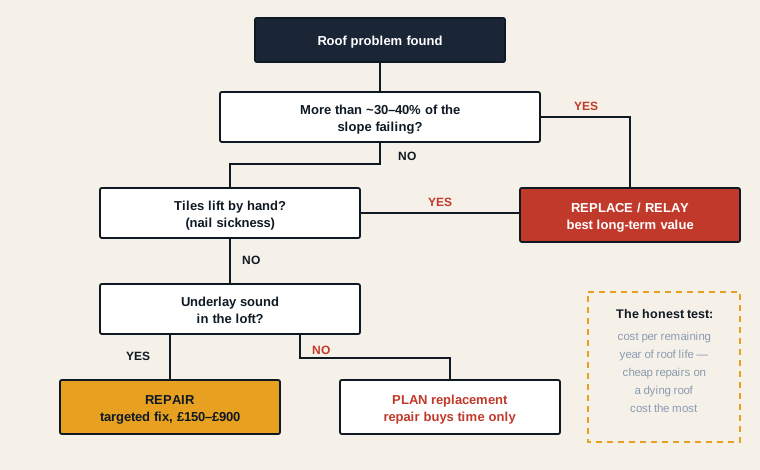
The repair-or-replace decision framework. We apply it honestly to your specific roof after a free survey.By Chippenham stock
Age and Condition by Chippenham Housing Era
The right answer depends heavily on which era of Chippenham house you own. The 1958–1978 concrete-tile estates — Hardenhuish, Stanley, Cocklebury — are the classic replacement candidates once nail sickness sets in: the concrete tiles themselves are often still sound, but the mild-steel nails holding them have corroded, so tiles slip across every slope. Once that happens, repairing tile-by-tile is a treadmill — each fix is followed by the next slip a few months later — and a full or phased re-roof is the honest call.
The Victorian and Edwardian stock around Monkton Park, Hartham and London Road is different. These clay and slate roofs can last well over a century, so widespread replacement is rarely needed — the failures are usually the leadwork (valleys, flashings, parapet gutters) and ridge mortar, all of which are repairs, not re-roofs. Replacing a sound Victorian clay roof would be oversell. The 1995–2010 Pewsham stock sits in between: the pitched roofs are young and sound, but the felt flat-roof extensions are now failing at end of life and are genuine replacement candidates — in GRP, not more felt.
The framework
The Three Tests That Decide It
1. How much has failed — the 30% rule
A rough industry rule of thumb: if more than about a third of the covering has failed, tile-by-tile repair stops making sense and replacement becomes better value. Below that, and where the failures are localised, repair is almost always the right call. On a Chippenham estate roof, "failed" usually means nail sickness across multiple slopes, not just a couple of slipped tiles.
2. How old is the covering
Concrete tiles last 40–60 years, clay and slate 80–120+, felt flat roofs 10–20. If your covering is near the end of that range and starting to fail, replacement resets the clock; if it has decades left and one area has gone, repair it. Age alone does not condemn a roof — a 60-year-old concrete roof with sound nails is fine — but age plus widespread failure points to replacement.
3. Cost per remaining year
This is the honest test. A £400 repair that buys two more years costs £200 a year. A £9,000 re-roof that lasts 50 years costs £180 a year — and comes with no leaks, no worry and a 10-year guarantee. Cheap repairs on a dying roof cost the most over time; that is the maths that should decide it, not the headline price of either option.
Honest both ways
When Each Is the Wrong Answer
When repair is money wasted: if your Hardenhuish or Stanley estate roof is shedding tiles across every slope from nail sickness, paying for repair after repair is throwing money away. Each fix holds for a few months, then the next tile goes. We will show you the repair cost and the re-roof cost side by side so you can see the cost-per-year difference for yourself.
When replacement is oversell: if a roofer tells you a sound Victorian clay roof in Monkton Park "needs replacing" because of a couple of slipped slates or a failed valley, be sceptical. Those are repairs. A whole-roof replacement quote for what is genuinely a leadwork or ridge repair is either incompetence or a hard sell — and it is exactly why an independent roof inspection before you commit to a big spend is worth the modest fee.
Repair when: damage is localised, the covering is sound, and the roof has years of life left.
Replace when: repairs are recurring, failure is widespread, or the covering is past its life.
Get an inspection when: you are unsure, buying, or facing a big quote you want checked.
A middle path
Phased Re-Roofing: The Chippenham Middle Path
There is a third option that suits a lot of Chippenham estate homeowners, and it is one the doorstep traders never mention: phased replacement. If your Hardenhuish or Stanley roof has nail sickness but you cannot face the whole cost at once, we can re-roof the worst slope now and the rest over the following year or two, spreading the spend. Each slope is done to full standard — new membrane, battens, dry-fix ridge — so you are not paying twice, just splitting the timing.
Phasing works because concrete-tile slopes fail at their own pace depending on exposure; the south-westerly-facing slopes on Chippenham's exposed estates usually go first. We prioritise the slope that is actively slipping or letting water in, make the others safe, and come back for them when your budget allows. It is not always the cheapest route overall — a single visit is more efficient — but for many households it is the difference between fixing the problem properly and limping along on repairs. We will tell you honestly whether phasing makes sense for your specific roof.
What it costs to wait
The Hidden Cost of Putting It Off
The most expensive choice of all is usually doing nothing. A roof that is shedding tiles or leaking does not stabilise — it gets worse, and the damage spreads from the covering into the things underneath it. A slipped tile lets water onto the felt; a failed felt lets it onto the battens and rafters; a soaked rafter end rots, and now you are paying for structural timber repair on top of the re-roof you needed anyway. On Chippenham's older stock we regularly see roofs where a £3,000 job five years ago has become a £9,000 one because the water got into the structure.
Interior damage compounds it. A roof leak that reaches the ceilings means replastering, redecorating and sometimes electrical work — costs that have nothing to do with the roof but flow directly from leaving it. Damp also brings mould, which is a health issue and, for landlords, increasingly a legal one. The honest maths is that a roof problem caught early and fixed properly is nearly always cheaper than the same problem left to spread — which is why we would always rather survey your roof sooner than later, even if the answer turns out to be "it is fine, leave it".
Buying and selling
Repair, Replace and Selling Your Home
If you are selling a Chippenham property, the roof matters more than almost anything to a buyer's surveyor. A roof with obvious nail sickness or visible failure will be flagged in the homebuyer's survey, and buyers will either renegotiate hard or walk away — often knocking far more off the price than the repair would have cost. A recent re-roof with a transferable 10-year guarantee, by contrast, is a genuine selling point that surveys note positively. If you are within a couple of years of selling and the roof is failing, doing it now often pays for itself at the negotiating table.
If you are buying, the opposite logic applies: an independent pre-purchase roof inspection tells you whether that Hardenhuish semi needs an £8,000 re-roof before you exchange, so you can renegotiate or budget rather than discover it afterwards. Either way, the roof is too expensive to guess about — a modest survey fee buys you the facts, and if you book the work with us the fee is credited against it.
The evidence
What Independent Guidance Says
“Repair is generally the more economical choice where damage is localised and the remaining covering is sound; replacement becomes cost-effective once defects are widespread or the covering has reached the end of its serviceable life.”— RICS / BRE building-condition guidance
Still not sure? That is exactly what our free survey is for. We will assess your specific Chippenham roof, apply the three tests honestly, and give you both options in writing where it is a genuine judgement call — then you decide. See also our guides to roof repairs, roof replacement and roof inspections.
Get In Touch
Not Sure? Get an Honest Answer
Free survey, honest advice, both options in writing where it is a close call. No call-out fee.